How to Get Accredited to Offer CLE Credits
If your organization wants to offer continuing legal education to attorneys and issue continuing education credits — whether you are a law firm running in-house programs, a bar association, a nonprofit, or a private CLE provider — you need to be accredited. Accreditation is not a single national process. Each state has its own rules, fees, and ongoing obligations.
This guide walks through how to become an accredited CLE provider step by step: what accreditation actually means, how to choose between provider-level and per-course approval, what you will need to apply, and how to keep your program compliant once you are approved.
What Does "Accredited to Offer CLE Credits" Actually Mean?
In most states, two parallel systems govern CLE accreditation:
- Provider accreditation — Your organization is approved as an authorized CLE provider. Once accredited, you can issue credits for courses that meet state standards without seeking individual course approval each time.
- Course-by-course approval — Each individual course is submitted and approved separately. This is appropriate for organizations that only run occasional CLE programs.
Provider accreditation is generally faster and more cost-effective in the long run if you plan to run more than a few CLE courses per year. Course-by-course approval makes sense for one-off events or for a single state.
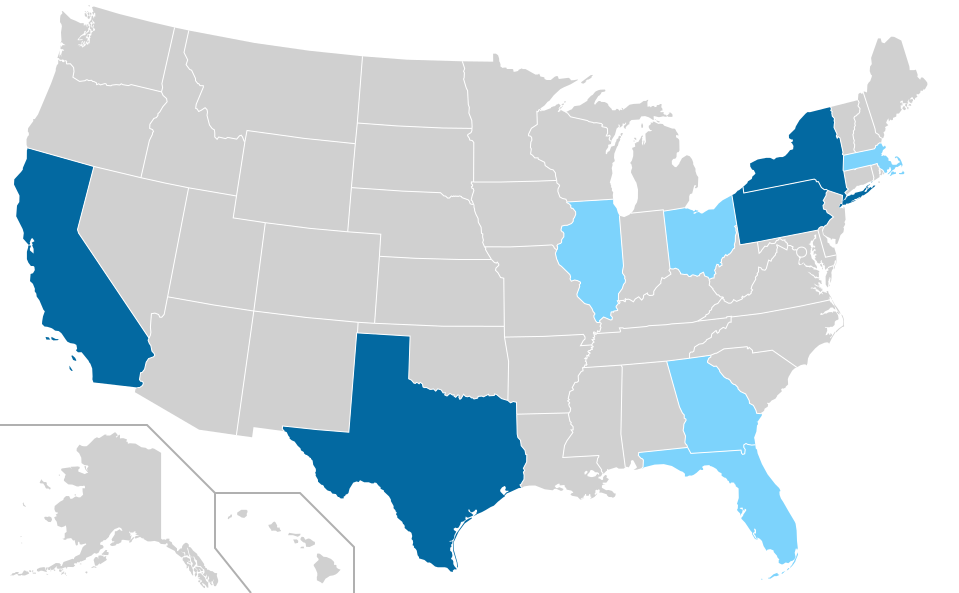
Some states (Pennsylvania, Delaware, and others) require all providers to apply for sponsor or provider status before offering any CLE credits. Others (such as New York and California) accept course-by-course submissions from any qualified organization.
Step 1: Research Your State's Requirements
Each state's bar or supreme court regulates CLE in its jurisdiction, and the rules vary significantly. Before you submit any applications, identify:
- Which state(s) you need accreditation in. Start with the states where most of your attorneys are licensed. Multi-state practices may need to apply in several jurisdictions.
- The specific accrediting body. This is usually a state bar's CLE board, the state supreme court, or a designated commission (the New York CLE Board, the Texas Minimum Continuing Legal Education Committee, the State Bar of California, and so on).
- Provider vs. course-level approval. Some states require provider accreditation; others allow course-only approval; many accept both.
- Reciprocity. A number of states grant reciprocal credit if your course is approved by another state's accrediting body. This can dramatically reduce the number of separate applications you need to file.
Our state-by-state CLE requirements pages maintain current rules for each jurisdiction, including hour types, reporting deadlines, and accrediting authorities. They are a useful starting point for scoping which states you will target.
Step 2: Choose Your Accreditation Strategy
The right strategy depends on how many states you operate in and how much CLE you plan to deliver.
Single state, occasional courses. Course-by-course approval. Lower upfront cost; you pay an application fee per course.
Single state, regular programming. Provider accreditation. One application, one annual fee, unlimited course offerings.
Multi-state with high volume. Provider accreditation in your highest-volume states, then rely on reciprocity for the rest. Most states will recognize courses approved in another reputable jurisdiction.
Multi-state with low volume per state. Course-by-course approval, with reciprocity claims where possible. This avoids paying provider fees in every jurisdiction.
For organizations planning to run more than a handful of CLE courses per year across multiple states, provider accreditation in your top two or three jurisdictions plus reciprocity is usually the most efficient path.
Step 3: Prepare Your Application Materials
Most state CLE accreditation applications require similar documentation. Gather these in advance:
- Organizational information. Legal name, address, federal tax ID, and organizational structure (nonprofit, for-profit, government, bar association). Some states require proof of nonprofit status or charge differential fees for nonprofits.
- Mission and CLE rationale. A brief description of why your organization is qualified to offer continuing legal education.
- Sample course materials. At minimum, a course outline, written materials, and instructor biographies for one or more sample programs. Some states require you to submit a complete past program for review.
- Instructor qualifications. Many states require that instructors be licensed attorneys in good standing in any U.S. jurisdiction, or qualified subject-matter experts. Plan to document credentials for each instructor.
- Recordkeeping plan. A description of how you will track attendance, issue certificates, retain records, and report credits to attorneys or state bars. This is where many applications stall — states want concrete answers, not vague promises.
- Application fee. Provider fees range from around $100 to over $1,500 depending on the state and your organization type.
A documented, automated system for the recordkeeping piece is often the difference between a smooth approval and a multi-round revision. Modern CLE management software handles attendance verification, certificate issuance, and compliance reporting in ways that satisfy most state requirements out of the box, which makes this section of the application much easier to answer.
Step 4: Submit Your Application
Most states accept applications online, though a few still require mailed paper packets. Expect:
- Review timelines of 30 to 90 days. You cannot issue credits until your application is approved, so plan ahead.
- Possible follow-up requests. Reviewers may ask for more detail on instructor credentials, sample materials, or your recordkeeping process.
- Conditional approvals. Some states grant provisional status pending a successful first program audit.
While you wait for approval you can develop your courses and prepare your delivery infrastructure. Just do not market them as CLE-eligible until you have written confirmation.
Step 5: Build Your CLE Program Operations
Approval is the start, not the finish. Once you are accredited, you are responsible for the operational side of running a CLE program. This includes:
Attendance verification. Live programs require some form of attendance confirmation — timed codes, sign-in sheets, or platform-based verification. On-demand courses require progress tracking and completion confirmation. Requirements vary; some states accept honor-system attestation, others require active verification with timed prompts or codes.
Certificate issuance. Every attendee who completes a CLE course needs a certificate that includes specific information: course title, date, hours awarded, your provider number, the attendee's bar number (where applicable), and your organization's signature or seal. Each state has its own formatting requirements. Issuing these manually for every course quickly becomes unmanageable; automated certificate generation is one of the highest-leverage operational improvements you can make.
Credit reporting. Some states (Ohio, Pennsylvania, Virginia, and others) require providers to submit credit reports directly to the state bar. Others require attorneys to self-report. If you are operating in a direct-reporting state, your software needs to produce the right export format.
Recordkeeping and retention. Most states require providers to retain CLE records for three to seven years. This includes attendance logs, course materials, evaluation results, and certificates. Built-in CLE reporting makes this part of normal operations rather than a separate project.
Multi-state compliance. If you are accredited in multiple states, each will have its own hour types (general, ethics, professionalism, technology, elimination of bias, and others), formatting, and deadlines. Multi-state compliance support is the difference between a manageable program and a constant fire drill.
Step 6: Maintain Your Accreditation
Provider accreditation is not permanent. Most states require:
- Annual renewal fees ranging from $100 to several hundred dollars
- Annual reporting of the courses you offered, hours delivered, and attendance numbers
- Ongoing compliance with state rule changes — many states publish CLE rule updates yearly
- Audit readiness. A small percentage of providers are audited each year. Auditors will request attendance records, course materials, certificates, and proof of recordkeeping practices.
Plan for these obligations from the start. The organizations that get into trouble with state CLE boards are usually the ones that treat accreditation as a one-time event rather than an ongoing operational discipline.
How CLE Hero Helps
CLE Hero is purpose-built continuing education management software for CLE providers. The platform handles the operational requirements that state bars look for in your accreditation application — attendance verification, automated certificate generation, multi-state compliance, recordkeeping, and reporting — so you can focus on building great programs instead of managing spreadsheets.
For organizations applying for provider accreditation, having a documented, automated CLE management system in place strengthens your application's recordkeeping section and accelerates approval. For accredited providers, the platform reduces the day-to-day administrative burden of running a compliant program across one or many states.
Start for free or schedule a demo to see how it works.
Frequently Asked Questions
How long does it take to become an accredited CLE provider?
Most states approve applications within 30 to 90 days. Have your sample materials, instructor credentials, and recordkeeping plan ready before you apply to avoid back-and-forth that can extend the timeline.
Do I need to be accredited in every state where my attorneys are licensed?
Not necessarily. Many states accept courses approved by other states' accrediting bodies through reciprocity. A common strategy is to obtain provider accreditation in two or three high-volume states and rely on reciprocity for the rest.
What does it cost to become an accredited CLE provider?
Application fees range from around $100 to $1,500 or more depending on the state and your organization type. Annual renewal fees are typically lower. Factor in ongoing operational costs as well — software, staff time, and any fees for direct credit reporting.
Can law firms become their own CLE providers?
Yes. Many law firms run accredited in-house CLE programs for their attorneys. This is often more cost-effective than purchasing third-party CLE for a full firm, and it lets you tailor content directly to your firm's practice areas.